
Camp County Court Records After Jail Arrest
A Camp County jail arrest creates more than one kind of record. The jail record is made by the Camp County Sheriff's Office when a person is booked at Camp County Jail. It can support custody checks, booking confirmation, and a public-information request for basic arrest material. The court record starts when a complaint, information, indictment, bond order, hearing notice, or other filing reaches the clerk. That is the record that tracks the criminal case after arrest.
The split matters in Camp County because the sheriff page does not publish a local case docket or a full jail roster with charge histories. Current custody starts with VINELink or the jail phone line, while filed charges must be checked through the district clerk, county clerk, or statewide court research tools when records are available. Custody and booking detail belongs with Camp County jail inmate records. Booking-photo questions belong with Camp County jail mugshots. Court records after a jail arrest are about the filed case, not just the booking event.
Camp County has two key clerk offices for criminal-record routing. District-court criminal records route to District Clerk Kelly Gunn at 126 Church Street, Room 204, Pittsburg, TX 75686. County-level criminal records route to County Clerk Sandra Knight at 126 Church Street, Room 102. The offices are in the courthouse area, separate from the sheriff and jail address on Tapp Street. That local geography often matches the record path: custody questions go to the jail, and filed charge questions go to the courthouse.
Find Camp County Court Records After Arrest
Start with the arrest date, full name, and any booking or case number that is already known. If the person is still in custody, the sheriff-linked custody channel may help confirm that the arrest occurred, but it does not replace a court search. For filed charges, contact the clerk office that handles the court level or use re:SearchTX, the official statewide court-record research portal. Access can vary by court, record type, user role, and whether an account is required.
The official Camp County district clerk page is the local contact point for felony-level district-court criminal files. It lists Kelly Gunn, phone 903-856-3221, fax 903-856-0560, email kelly.gunn@co.camp.tx.us, and office hours from Monday through Friday with a lunch closure. The Camp County county clerk page lists Sandra Knight, phone 903-856-2731, fax 903-856-6112, email sandra.knight@co.camp.tx.us, and similar courthouse hours for county-level records.
The re:SearchTX portal is a matched source for statewide court research.
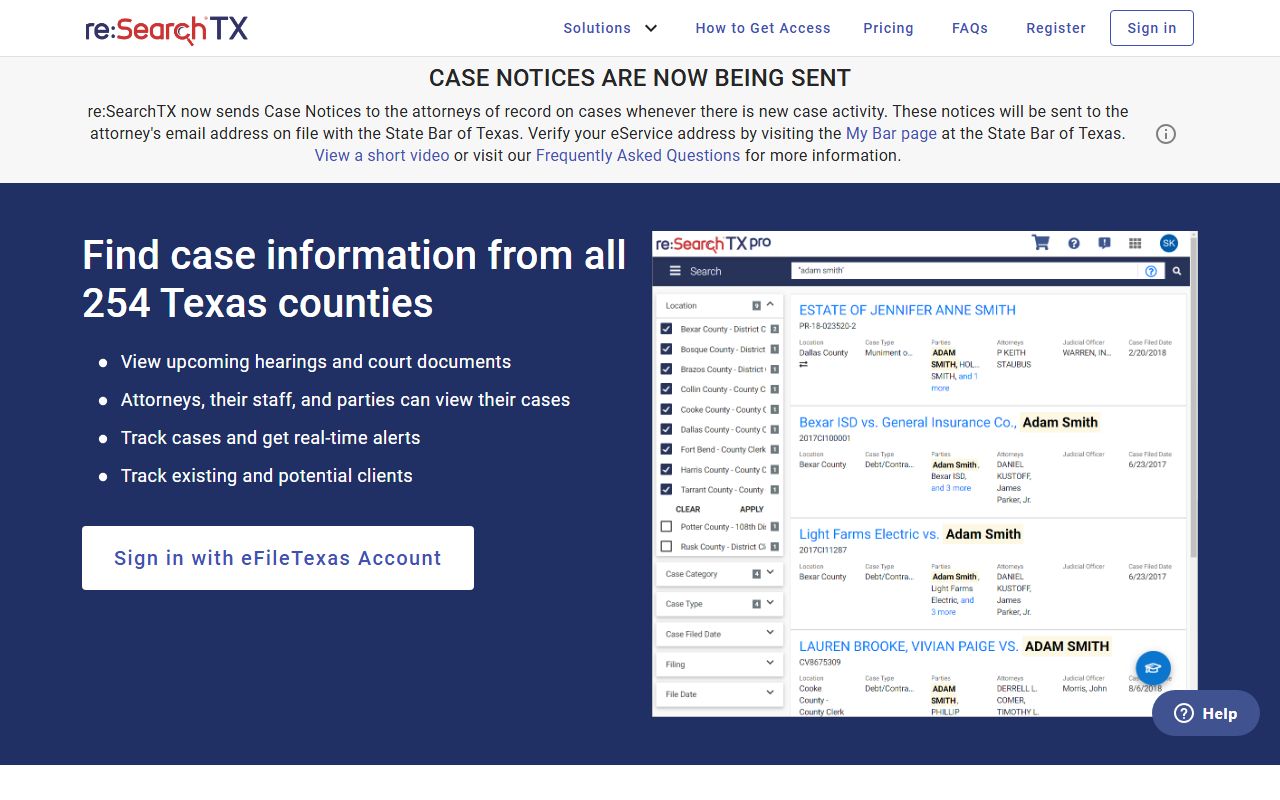
Use the portal as a court-record path, then verify local availability with the Camp County clerk office that maintains the case.
- Confirm the booking or arrest through VINELink or the Camp County Sheriff's Office if custody is still uncertain.
- Decide whether the case is likely a felony, county-level misdemeanor, juvenile matter, or lower-court matter.
- Search re:SearchTX by party name, case number, court location, and date range if those fields are available.
- Call the district clerk or county clerk when the portal does not show a filed case or when document access is limited.
- Ask for the filing date, charge wording, case number, next setting, bond order, and disposition status.
| Search Field | Type | Required | Camp County Use |
|---|---|---|---|
| Party or defendant name | Text | Varies | Use full name and spelling from the booking record when possible. |
| Case number | Text | No | Best when a clerk or attorney has already provided a case number. |
| Location or court | Filter | No | Filter to Camp County or the relevant court if the portal offers it. |
| Date range | Date filter | No | Use the arrest date or likely filing window to narrow common names. |
| Login or account | Account | May be required | Some documents or features may need registration or may not be public. |
Camp County Court and Prosecutor Contacts
The prosecutor decides which charges to pursue after an arrest, but the clerk keeps the court record once a case is filed. Camp County research identifies two prosecutor offices. District Attorney Chuck Bailey is listed on the official district attorney page with a mailing address at P.O. Box 249, Mount Pleasant, TX 75456-0249 and phone 903-577-6726. County Attorney James W. Wallace III is listed on the county attorney page at 126 Church Street, Room 101, Pittsburg, TX 75686-0970, with phone 903-856-2409.
District Clerk
126 Church Street, Room 204
Pittsburg, TX 75686
903-856-3221
District-court criminal records and felony filings.
County Clerk
126 Church Street, Room 102
Pittsburg, TX 75686
903-856-2731
County-level criminal records and local filings.
District Attorney
P.O. Box 249
Mount Pleasant, TX 75456-0249
903-577-6726
Prosecutor review for filed charges.
Do not assume that a charge listed at jail booking is the same charge that appears in a Camp County court record after arrest. Prosecutors may decline, amend, reduce, or add charges after reviewing reports and evidence. A clerk can confirm whether a case exists, but legal advice about the charge should come from counsel.
Camp County Arrest Charging Documents
Charging documents are the bridge between an arrest and the court record. A complaint can set out the sworn accusation. An information is a prosecutor-filed charging document often used for non-indictment cases. An indictment is a grand-jury charging document, most often tied to felony prosecution. Camp County research does not locate a county-specific public criminal case-search page, so these document types are best confirmed through the district clerk, county clerk, defense counsel, or re:SearchTX when the record is available.
| Document | Who Files or Issues It | Common Use | What to Ask the Clerk |
|---|---|---|---|
| Complaint | Officer or prosecutor | Early sworn charge after arrest | Whether a complaint has been filed and under which case number. |
| Information | Prosecutor | Some non-indictment criminal cases | Whether the information changed the booking charge wording. |
| Indictment | Grand jury | Felony prosecution | Whether the grand-jury charge differs from the arrest allegation. |
Texas Code of Criminal Procedure Article 15.17 also matters after arrest. It requires a person arrested in Texas to be taken before a magistrate without unnecessary delay, generally within 48 hours. That first appearance is where warnings, counsel information, and bail issues may be addressed. It is not the same as a final court disposition.
Camp County Charge Status Records
Charge status can change several times after a jail arrest. A Camp County booking may start with one alleged offense, while the filed court charge may be amended or reduced. A dismissed charge is not a conviction. Deferred adjudication is a Texas disposition that can involve supervision before final adjudication if conditions are met. A conviction or adjudication means guilt or responsibility has been determined by plea, verdict, or court action.
| Status | Meaning in Court Records | Why It Matters After Arrest |
|---|---|---|
| Pending | The case is unresolved. | Future hearings, bond conditions, and filings may still change the record. |
| Amended | The charge wording or count changed. | The final filed charge may differ from the jail booking charge. |
| Reduced | A lesser charge replaced a more serious one. | Searchers should not treat the arrest charge as the final case outcome. |
| Dismissed | The charge is not proceeding. | Eligibility for record clearing may depend on the exact dismissal and case history. |
| Acquitted | The defendant was found not guilty. | The court record may still exist unless later cleared by court order. |
| Convicted or adjudicated | Guilt or responsibility was determined. | Statewide conviction-history tools may later reflect the outcome. |
Bond Orders After Camp County Arrest
Bond is part of the court pathway after many arrests. Texas Code of Criminal Procedure Chapter 17 governs bail, personal bonds, sureties, and bond conditions. Camp County did not publish a local online bond desk page, accepted payment list, or 24-hour cashier schedule in the sources reviewed. Confirm custody, bond status, and payment procedures with Camp County Jail at 903-856-6651 before relying on a third-party payment claim.
| Bond Type | How It Works | Camp County Research Note |
|---|---|---|
| Cash bond | The full amount is paid as security for court appearance. | Local payment methods were not posted by the sheriff. |
| Surety bond | A licensed bail bond company posts bond for fee or collateral. | Confirm the exact jail procedure before posting. |
| Personal or PR bond | Release is based on a promise to appear, sometimes with conditions. | It depends on the magistrate or court decision. |
| No-bond hold | Ordinary bond release is unavailable. | Can involve warrants, parole holds, detainers, or court orders. |
| Property bond | Property is used as security. | Local availability was not posted online. |
Bond release does not close the case. A person may leave Camp County Jail and still have court settings, conditions, or pending charges. Check the clerk record after release to confirm the filed case, next court date, and whether the charge has changed.
Camp County Warrants and Arrest Records
No official Camp County sheriff active-warrant search page or most-wanted page was found in the research. Warrant questions should be confirmed with the sheriff, the clerks, or the issuing court. A warrant arrest can produce both a booking record and a court record, but the warrant itself may come from a different court or even another county. Bench warrants, capias warrants, fugitive holds, parole warrants, and ordinary arrest warrants can each affect release in different ways.
For Camp County warrant-related court records after arrest, call the sheriff at 903-856-6651 for custody confirmation, then ask the district clerk or county clerk whether a case or warrant file exists under the person's name. The district court schedule page lists court scheduling contacts for hearings with Judge Saucier or Judge Kopech, but it is not a warrant hotline. Use it for setting context, not for direct warrant clearance.
Charges vs Convictions After Arrest
An arrest charge is an accusation. A conviction is a final court outcome by plea, verdict, or other adjudication. Camp County court records after a jail arrest can show both early allegations and later dispositions, so the date and status of each entry matter. Texas DPS also offers a criminal-history conviction name search, but that tool is not a live jail roster and is not a full local docket.
| Issue | Charge | Conviction |
|---|---|---|
| Stage | Accusation after arrest or prosecutor filing | Final finding or plea outcome |
| Proof level | Probable cause or formal allegation | Beyond a reasonable doubt or accepted plea |
| Where found | Booking record, complaint, information, indictment, docket | Judgment, sentence, conviction history when reported |
| Reader caution | Can change or be dismissed | Still verify identity and case details with the originating office |
Sealed and Expunged Camp County Arrest Records
Texas Code of Criminal Procedure Chapter 55 governs expunction for qualifying arrest and criminal records. Expunction is a court process. It is not the same thing as asking a website to remove a page or asking the jail to hide a record without a court order. Non-disclosure can limit public access to some records, but it is distinct from expunction and has separate eligibility rules.
| Record Status | Public Visibility | Practical Effect |
|---|---|---|
| Sealed or non-disclosed | Limited from ordinary public access | Some agencies or authorized users may still have access under Texas law. |
| Expunged | Destroyed or treated as not existing for many purposes | Agencies holding records must follow the court order. |
| Not cleared | May remain public if no exception applies | Verify current status with the clerk, not with a stale search result. |
Texas access rule: Texas Government Code Chapter 552 governs public-information requests, and Section 552.108(c) preserves access to basic information about an arrested person, an arrest, or a crime even when some law-enforcement material may be withheld.
Restricted Camp County Court Records
Not every document tied to a Camp County arrest is open to the public. Juvenile records, sealed records, expunction orders, active investigation material, sensitive victim information, medical data, and some law-enforcement records may be restricted. A clerk can often confirm whether a public case exists without releasing every document in the file. The sheriff may also withhold some jail or investigative records under the Texas Public Information Act when an exception applies.
Use careful wording when requesting restricted or uncertain records. Ask for the case number, public docket sheet, charge list, disposition, and next setting. For jail material, ask for basic arrest information or the booking record. If the office denies all or part of a request, the response should identify the reason or the review process under Texas public-information practice.
Important: These records are not consumer reports and must not be used for credit, employment, housing, insurance, or other FCRA-regulated screening.